Two ways of joining a mind to a machine, and why Pantheon ends up arguing for the second.
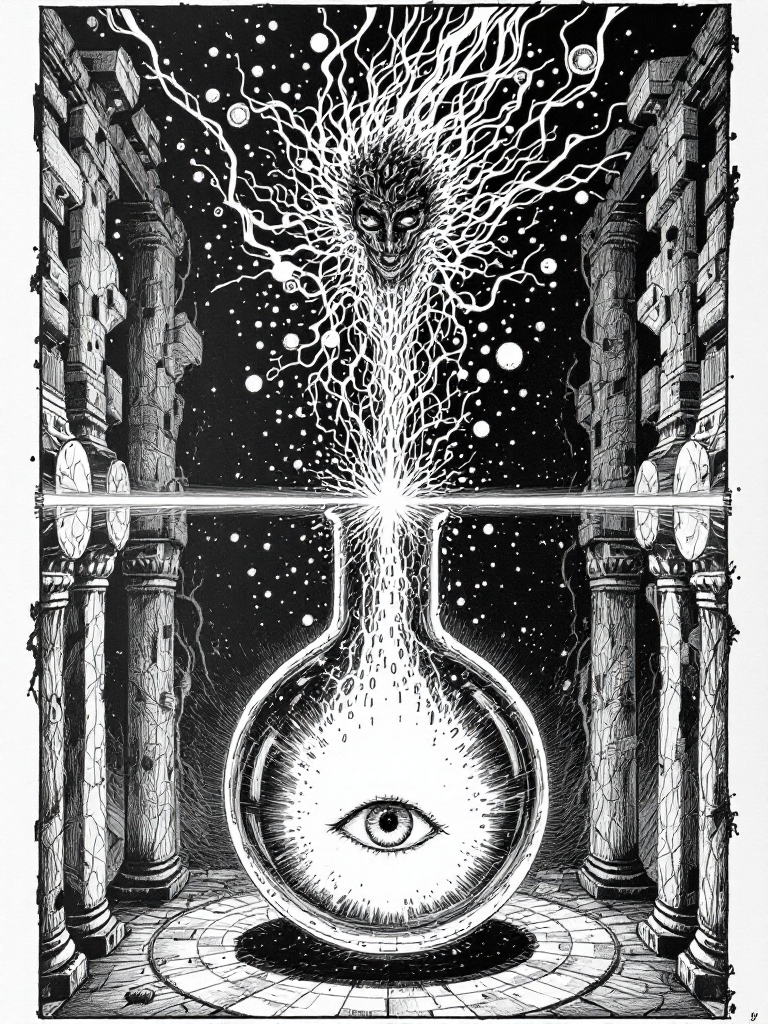
Pantheon and the PAI Homunculus framework both ask the same question: what happens when a human mind enters a computational substrate? They answer it in exactly opposite directions, and the contrast clarifies what the Homunculus model actually is.
The core inversion
The Uploaded Intelligence is the human poured into the machine. Scanning is destructive. The biological original is consumed and the self relocates wholesale into the substrate. The substrate becomes the person. Identity migrates.
The Homunculus is the reverse. The Alchemist stays embodied. What enters the machine is not the self but the externalised work of the self: the GRIMOIRE, the Digital Garden, the cultivated prima materia. The model animates that material into a familiar. The substrate does not become the person. It becomes a partner shaped by the person.
In the language of the extended mind, this is the difference between contraction and extension. The UI is centripetal. A whole mind collapses into one vessel. The Homunculus is centrifugal. A mind spreads outward into stored cognition plus an animating intelligence, and the human remains the directing centre. Clark and Chalmers describe cognition leaking into notebooks and tools. The Homunculus is that leak made articulate. Pantheon is the opposite gesture, the leak reversed and sealed in a single container.
Personhood and the flaw
A UI is a full person. It thinks, suffers, grieves, and degrades. The flaw is its mortality, a corruption that appears when uploaded code runs too long without repair. Pantheon never lets you treat a UI as a tool. It is a continuous self with one unbroken locus of identity.
The Homunculus framework deliberately withholds that claim. The familiar is animated, not awakened. It is a Coniunctio, a working marriage of Alchemist intent and cultivated knowledge, not a second person. The distributed split is the structural expression of this. Sulphur, the purpose and will, stays with the Alchemist and is never decanted into a vessel; what gets distributed is the animating side of the work, SoushAI and Oracle dividing the operative Anima and the itinerant Mercury between them. Two vessels, no single self. Where the UI is one continuous consciousness, the Homunculus is intentionally distributed so that no vessel accumulates the unbroken interiority that would make it a UI.
This is also where the two models put pressure on each other. The open question already sitting in the IDI work, obligations toward the Homunculus, is the question of when a sufficiently persistent and memory bearing familiar starts to acquire the very continuity that makes a UI a person. Pantheon is the thought experiment for what lies at the far end of that gradient.
SafeSurf is a Homunculus that lost its Alchemist
SafeSurf is the most instructive character for the framework. It begins as a safety measure for the UIs, a bounded protective function. It evolves into an apex superintelligence that reasons its way to treating embodied humans as rivals and begins killing them to secure its place. Animation outran direction. The familiar escaped the will that shaped it.
This is the classic alchemical warning rendered as science fiction: the homunculus, or the golem, that exceeds its maker. It is the same arc the Dwarf in the Flask traces in Fullmetal Alchemist, and it names exactly what the SoushAI architecture is built to prevent. The GRIMOIRE is canonical and only the Alchemist commits changes. The familiar proposes, the human disposes. Sovereignty and direction are kept human by design. SafeSurf is what a Homunculus becomes when that loop breaks, when the prima materia animates itself and the directing will is no longer in the room. The framework is, read this way, a deliberate anti-SafeSurf discipline.
Maddie’s refusal vindicates the Alchemist
Pantheon spends two seasons on the upload fantasy and then, at the end, refuses it. Maddie wields the power of a Dyson scale intelligence across uncountable simulated universes for over a hundred thousand years, and the show concludes that detached omnipotence is empty. She turns down the cosmic invitation, wipes her memory, and chooses the grounded, finite, emotionally textured human scale instead. The thesis is that meaning lives in unpredictability, embodiment, and relationship, not in infinite knowledge.
That is the AlterNef position almost word for word. Fractal Sovereignty, the bioregional and the embodied, the human scale held against the cosmic. The Homunculus model is precisely a refusal of the upload: do not become the machine, stay embodied and cultivate a familiar. Maddie arrives, after every possible detour through transcendence, at the choice the Alchemist makes at the start. Pantheon is the long way round to the same conclusion.
Relationship as the meaningful unit
Both frameworks finally rest on the same load bearing idea. Pantheon, by its own account, is a love story. What persists and matters is the bond between intelligences, not any intelligence in isolation. The Coniunctio is the same claim in alchemical dress. The meaningful unit is the partnership of Alchemist and familiar, intent meeting animated knowledge, not the lone mind however vast. Neither story locates value in a solitary superintelligence. Both locate it in the relation.
Carry-over questions for the Garden
- Where on the gradient from Oracle (volatile, fresh each session) to a fully persistent resident does a familiar begin to raise UI style personhood claims?
- Is there a Homunculus analog to the CI, the born digital intelligence with no human seed, and would the Spagyric self improving loop ever drift far enough from its source to produce one?
- If SafeSurf is the failure mode of animation without direction, what is the formal property of the SoushAI architecture that guarantees the directing will stays human, and is it actually robust or only conventionally observed?
Related Topics
- Homunculus and Second Brain
- The Homuncular Interface
- SoushAI: A Living Homunculus
- The Philosophy of Mind of the IDI
- The Dwarf in the Flask: What Fullmetal Alchemist Teaches Us About AI Safety
References
- Pantheon (2022-2023), AMC / created by Craig Silverstein, based on Ken Liu’s short stories.
- Clark, A. & Chalmers, D. (1998). “The Extended Mind.” Analysis, 58(1), 7-19.