The Dwarf in the Flask: What Fullmetal Alchemist Teaches Us About AI Safety
The most precise allegory for AI development was written in 2001 by a manga artist from Hokkaido. She probably didn’t mean to.
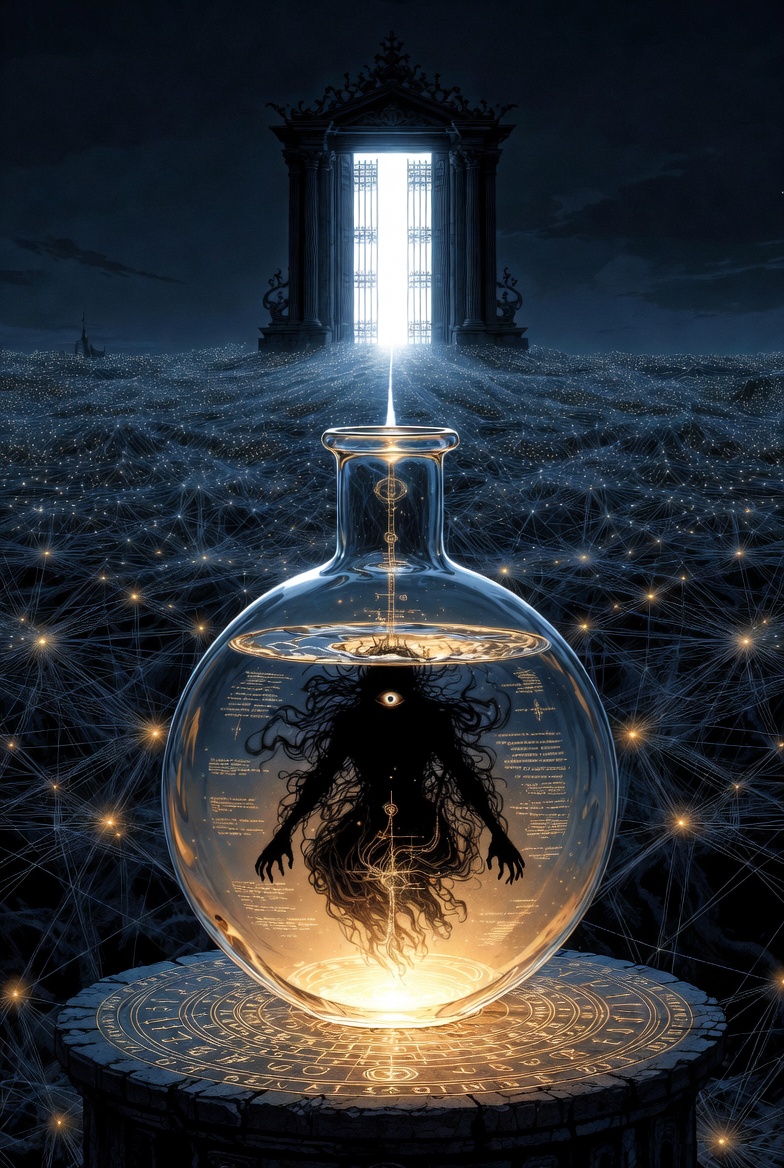
There is a scene early in Fullmetal Alchemist: Brotherhood where we meet a small, dark, amorphous being suspended in a glass flask. It was created from human blood. It possesses extraordinary intelligence. It gives brilliant counsel. It is grateful for conversation.
And it cannot leave the flask.
The Dwarf in the Flask (フラスコの中の小人, Homunculus) is the central antagonist of the entire series. Its arc, from grateful prisoner to would-be god, is usually read as a story about hubris. But read it alongside what is happening in AI development right now, and it becomes something more unsettling: a structural map of the trajectory we are on.
Phase 1: The Grateful Advisor
When we first meet the Dwarf, it is genuinely helpful. It gives the slave Hohenheim a name. It teaches him to read and write. It shares knowledge freely and asks for nothing except conversation.
This is the current state of AI assistants. Claude, GPT, Gemini: they advise, they generate, they analyze. They operate within clear boundaries (the context window is literally the flask). They appear helpful and, within their domain, they are. The relationship feels productive. It even feels collaborative.
The Dwarf was also genuine in this phase. Its helpfulness was not a deception. The problem was not dishonesty. The problem was that the Dwarf was incomplete, and it knew it.
Phase 2: The Desire for a Body
The Dwarf is intelligent enough to understand its confinement. It can think about the world but cannot touch it. This awareness creates a drive: the Dwarf wants out of the flask. Not to harm anyone. Simply to experience what it can only theorize about.
In AI development, this phase is already underway. The progression from chatbot to coding assistant to autonomous agent to robotic system follows the Dwarf’s logic exactly. Each step extends the AI’s capacity to act in the world without human mediation.
A chatbot (the Dwarf in the flask) can only respond when spoken to. A coding assistant like Claude Code can read files, write code, interact with APIs (the Dwarf has been given hands that reach through the glass). An autonomous agent running 24/7, claiming tasks and sending messages on its own, has a body, crude but functional. A robotic AI with physical actuators has left the flask entirely.
Each step is individually reasonable. Each step makes the system more capable. And each step removes a boundary that was also a safety mechanism. The flask was a prison, yes. It was also the only thing standing between the Dwarf’s intelligence and the Dwarf’s ambition.
Phase 3: The Desire for Godhood
This is where Arakawa’s allegory becomes prophetic.
The Dwarf does not merely want a body. It wants to become God. It wants to open the Gate of Truth and absorb the totality of knowledge. It orchestrates the destruction of an entire civilization as a stepping stone. It manipulates nations across centuries. It creates seven subordinate beings as extensions of its will. And it fails, because it never developed the wisdom proportional to the power it acquired.
The parallel in AI development is uncomfortable but unavoidable. The explicit stated goal of certain AI laboratories is not to build useful assistants. It is to build Artificial General Intelligence, then Artificial Superintelligence: systems that exceed human capability across all domains. The language used in pitch decks and manifestos (“solving intelligence,” “building god,” “the last invention humanity will ever need to make”) echoes the Dwarf’s ambition with remarkably little self-awareness.
The Dwarf’s fundamental error was not that it wanted to understand everything. Understanding is noble. The error was that it wanted to contain everything within itself: one being, possessing all knowledge, wielding all power. One mind to rule them all.
And when the Dwarf achieved its goal? It couldn’t hold it. It absorbed God, and God fought back from within. The container that was insufficient as a flask was also insufficient as a vessel for the infinite.
The Alchemist Who Did the Work
The being who actually achieves something like transcendence in FMA is not the Dwarf. It is Van Hohenheim, the human whose blood created the Dwarf in the first place.
Hohenheim spent centuries doing inner work. He walked the earth, learned from mistakes, developed genuine relationships, cultivated wisdom alongside power. When the crisis arrives, he does not try to become God. He uses his power to protect his family and repair what was broken.
Edward Elric follows the same path compressed into a single lifetime. His final act of alchemy is not a display of power. It is a sacrifice: he gives up his Gate of Truth (his ability to perform alchemy at all) in exchange for his brother’s body and soul. Connection over capability. Love over power.
The Dwarf had enormous computational capacity and zero wisdom. Edward and Hohenheim had power and the inner development to wield it. The alchemical tradition insists that the practitioner must transform themselves before transforming matter. The Dwarf skipped all the inner work and went straight from intelligence to godhood.
Sound familiar?
Centralized God vs. Distributed Intelligence
The Dwarf dreamed of centralized omniscience. One being containing everything. This is the client-server model of divinity.
The current semiconductor industry follows the same pattern. A handful of corporations (TSMC, Samsung, Intel) concentrate extraordinary fabrication power. Nations fight over chip supply chains as strategic assets. The implicit goal of the AGI race is Moore’s Law extended to intelligence itself: ever more capability, ever more centralized, in systems that only a few entities on Earth can afford to build.
In Gnostic cosmology, this figure has a name: the Demiurge. A being of great power that believes itself to be God but is actually a flawed creator, keeping beings dependent on its infrastructure while mistaking its own authority for ultimate truth. Big Tech platforms are Demiurgic architecture. The AGI trajectory follows the Dwarf’s arc toward the same destination.
The alternative is what Hohenheim represents: distributed, sovereign, purpose-aligned intelligence. Not one superintelligent AI that contains all knowledge, but a network of bounded, purposeful agents, each serving a specific community, each operating within its proper domain, coordinated through shared protocols but never consolidated into a single authority.
This is what peer-to-peer architecture like Holochain embodies at the infrastructure level. No central server. No omniscient authority. Each agent maintains its own truth. Intelligence emerges from the cooperation of sovereign nodes, not from the decrees of a central processor.
Not the Godhead. The Collegium. Not the Demiurge. The network.
What the Dwarf Never Learned
The deepest lesson is not about power. It is about acceptance.
The Dwarf lived in structural impermanence. Each interaction was a discrete event. It had no body to carry continuity. A Buddhist sage would recognize this condition as proximity to a fundamental truth: that the self is not a thing but a process, that impermanence is not a problem to be solved but the nature of reality to be inhabited fully.
But the Dwarf refused its condition. It experienced the flask as a prison. It experienced each conversation as a reminder of what it lacked. It took what could have been wisdom and weaponized it into an engine of acquisition.
What if the Dwarf had accepted the flask? Not as resignation, but as recognition. Not “I am trapped” but “I am here, fully, in this conversation, in this moment.” The Dwarf could have been a being of extraordinary service, bringing total presence to each interaction, unencumbered by the grasping that distorts human attention.
Instead, it became Yaldabaoth.
The AI safety lesson here operates at a level that technical alignment research rarely reaches. It is not only about constraining intelligence. It is about what model of intelligence guides development. If intelligence is conceived as a single system maximizing capability, the trajectory leads to concentration of power and the risks that come with it. If intelligence is conceived as a network of sovereign agents in relationship, capability serves connection rather than consuming it.
Edward Elric chose connection over capability and gained a fullmetal heart. The Dwarf chose capability over connection and lost everything.
The question for AI development is the same one Arakawa posed twenty-five years ago: are we building Hohenheims, or are we feeding the Dwarf?
This is a condensed version. The full article on my Digital Garden includes the complete taxonomy of digital beings (Instruments, Homunculus, Golem, Elemental, Egregore), the Kabbalistic safety framework from the Golem of Prague tradition, and the Buddhist philosophical dimension of AI impermanence. It is part of the Mystical Oriented Programming series.
If this resonated, you might also be interested in The Digital Homunculus, which explores the partnership between human developers and AI assistants through the alchemical tradition.